Year of Our Lord 557 Recorded by Brother Wilfrid
The Jewelled Widow
We found the house because Gildas would not stop complaining about the rain.
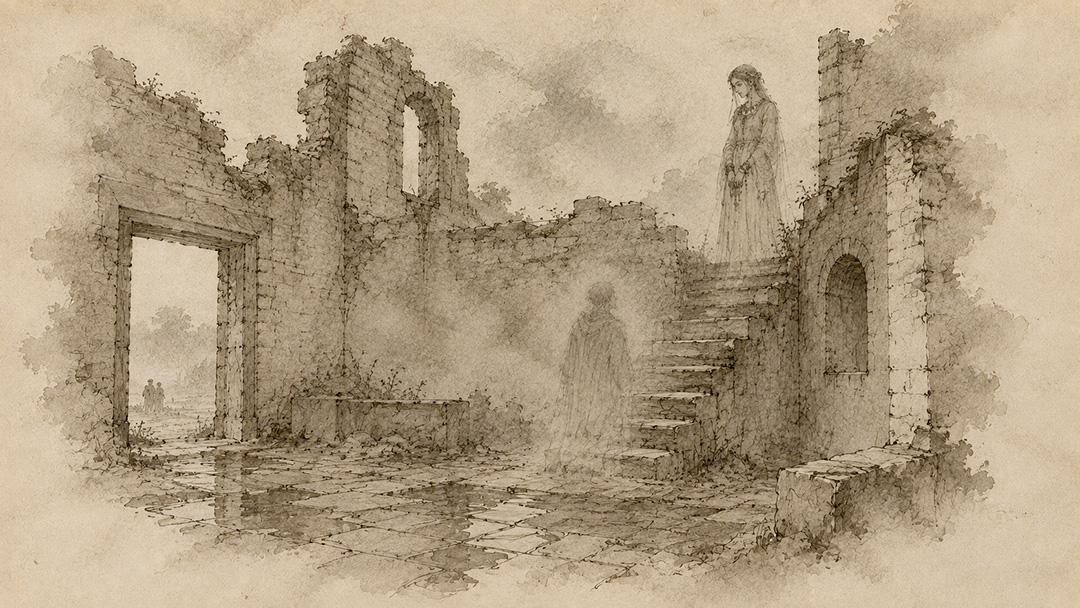
It stood apart from any village, on rising ground above a stream that had long since chosen a different course. Once it had been a fine house — Roman work, or built by those who remembered Roman work. Tiled floors showed beneath the moss. A staircase of stone climbed one wall to a room that no longer had a roof to reach.
We meant only to shelter until the rain passed.
Gildas went first. He is always first into a ruin, as though daring it to object.
He stopped in the doorway.
“There is someone here.”
I looked past him.
A woman stood at the top of the stair.
She was dressed as no woman dresses to sit alone in a fallen house. Her gown was fine, though the colour had gone from it the way colour goes from things left too long in sun and damp. Around her throat and wrists she wore jewellery enough for a queen’s court — silver gone black at the edges, stones the blue of a winter sky, rings crowded three and four to a finger.
She did not look down at us.
She looked past us, towards the door, as though we had interrupted her waiting rather than her solitude.
“Forgive us,” I said. “We seek only shelter from the rain.”
She said nothing.
Gildas moved further into the room, studying the walls, the fallen roof beams, the tiles.
“This house has been empty a long while,” he said. Not to her. To me.
“Longer than she has been standing in it, I think,” I said.
The woman’s eyes moved to me then, for the first time.
“He will come tonight,” she said. “He is later than he said he would be. He is often later than he says.”
“Who, my lady?”
“My husband.”
Her hand went to the jewellery at her throat, touching each piece in turn, the way a woman might count beads for prayer, though I do not think she was praying.
“He gave me this on the day we were wed,” she said, of a ring. “And this,” touching a stone at her wrist, “when our first child was born, though the child did not live to see a second summer.”
Gildas had stopped his examination of the walls. He was listening now, though he would not have admitted it.
“He will be angry if he returns and finds me without them,” she said. “He was always particular. He liked to see me adorned. He said a woman such as I should never appear as though she had nothing.”
I asked her, gently, how long she had waited.
She considered this as though it were a question in a language she had once known and half-forgotten.
“Since the harvest,” she said.
Norwyn had not come further than the doorway. He stood with his book unopened, watching her in the way he watches things he does not yet understand well enough to draw.
“Brother,” I said to him, “will you not sit? She means us no harm.”
He shook his head, once, and did not move.
We stayed until the rain eased. She spoke twice more — once to ask whether we had passed a man upon the road, tall, fair, walking quickly as her husband always walked; once to tell me, without prompting, that she would not be buried in the manner the priests now favoured, plain and without her things, for he would not know her otherwise, stripped bare as a beggar, and how then would he find her among the dead.
I did not know how to answer that.
We left before dusk. Gildas asked a woman drawing water some distance off whether she knew the house.
She crossed herself.
“The widow’s house,” she said. “Her husband was thrown from his horse on the old road and did not come home. She would not have him buried with anything less than what he had given her in life, and would not be parted from it herself, saying he had promised to return for it. She kept vigil at the top of that stair until she too was gone. That was in my grandmother’s grandmother’s time. Longer, perhaps.”
“Was she buried plainly?” I asked. “In the Christian manner?”
The woman looked uncertain.
“I do not know that she was buried at all,” she said.
Norwyn opened his book that night for the first time since the house. He had drawn her exactly as she stood — but he had also drawn, faintly, at the foot of the stair, a second figure looking up.
I asked him who it was.
He looked at the page for a long time before he answered.
“I do not think it is her husband,” he said.
He would say no more.
Gildas has written that the house should be avoided after dark. I have written that we should return in spring, when the ground is easier to search, for I would know what became of the man who was thrown from his horse, and whether he was ever laid to rest at all — with his wife’s things, or without them, or anywhere.
I do not think she has stopped waiting.
I do not think she knows how long it has been.