
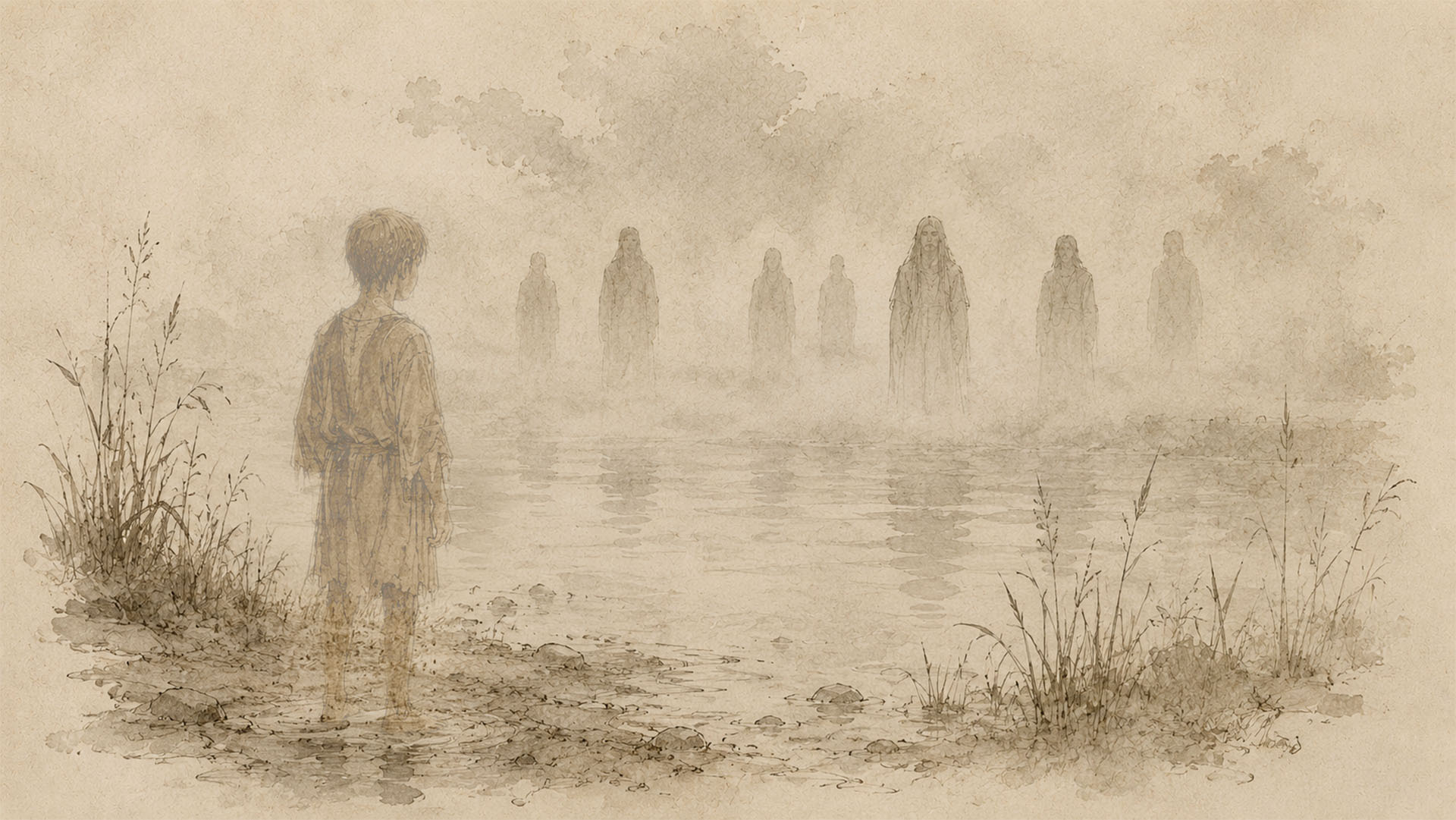
The Boy at the Ford
Year of Our Lord 557
Recorded by Brother Wilfrid
There is a ford north of Eoforwic where the river runs shallow between two banks of alder.
We had been warned not to cross it after sunset.
The warning came from an old farmer whose name I have forgotten, though I remember his hands. They were large and cracked from the earth, and he had the habit of rubbing his thumb against his fingers whenever he spoke of something he did not wish to remember.
He told us that a boy could sometimes be seen beside the water.
“Do not follow him,” he said.
Brother Gildas asked why.
The farmer looked at him.
“Because he is dead.”
Gildas thanked him for his wisdom.
The farmer did not smile.
We reached the ford shortly before evening.
The river was low, and the stones beneath the water could be clearly seen. There had been little rain, and I thought the farmer’s warning was foolishness.
Brother Gildas thought so too.
Brother Ystradwel said nothing.
He had been looking at the trees.
We crossed before the sun had fully disappeared.
On the far bank we made a small fire and ate what remained of our bread.
It was then that we heard a child laughing.
Gildas stopped chewing.
We listened.
The sound came from the river.
I stood and walked towards the bank.
A boy was standing among the alder trees.
He could not have been more than eight or nine years old.
His hair was wet.
His clothing was wet.
Water ran from his sleeves and gathered around his bare feet.
Yet the ground beneath him was dry.
“Come away from the river,” I called.
He looked at me.
Then he pointed towards the water.
I asked him his name.
He did not answer.
Instead he said:
“Don’t let them cross.”
“Who?”
He pointed again.
There was nobody on the river.
I looked upstream.
Nothing.
Downstream.
Nothing.
When I turned back, the boy was closer.
“Don’t let them cross,” he said again.
Brother Gildas had joined me.
“Who is he?” he whispered.
“I do not know.”
The boy looked at Gildas.
“They are coming.”
Gildas stepped towards him.
“Who are?”
The boy’s face changed.
He looked frightened.
“Behind you.”
We both turned.
There was nothing there.
When we looked back, the boy had vanished.
Gildas walked to the place where he had been standing.
He searched the ground.
There were no footprints.
Only the flattened grass.
Ystradwel came down to the river carrying his book.
He did not ask where the boy had gone.
Instead he showed us what he had drawn.
It was the boy.
But behind him were seven figures.
All standing in the river.
All facing us.
I asked Ystradwel when he had drawn them.
He looked at the page.
“I thought you had seen them.”
Neither Gildas nor I had.
We returned to the fire.
None of us slept.
At first light we went back to the ford.
The river was still.
There was something caught between two stones near the bank.
It was a child’s shoe.
I took it from the water.
It was very old.
The leather had become hard, and the sole was almost worn away.
We followed the river downstream for some distance.
After an hour we found the remains of a small settlement.
There were only three houses, though one had fallen almost entirely into the earth.
An old woman was sitting outside the largest.
When I showed her the shoe she began to weep.
She told us that her brother had drowned there when she was a child.
His name was Ceredig.
He had been eight years old.
He had disappeared in the river.
His body had never been found.
I asked where.
She pointed towards the ford.
I asked whether the ford had always been there.
“No,” she said.
“The river used to run farther west.”
Brother Gildas looked at me.
Neither of us spoke.
The old woman took the shoe from my hand.
She held it against her chest.
“He always hated the water,” she said.
Then she looked towards the river.
“Why has he come back now?”
I had no answer for her.
That night, we crossed the ford again.
The boy was waiting on the far bank.
This time he did not speak.
He only watched us.
I walked towards him.
He did not move.
When I was close enough to see his face clearly, I noticed something I had not seen before.
His clothes were wet.
His hair was wet.
But his face was dry.
He looked past me.
Towards the river.
Seven figures stood in the water.
They were far away, almost hidden by the evening mist.
I could not see their faces.
The boy took my hand.
His fingers were cold.
“Not them,” he whispered.
“Who are they?”
He looked at me.
“Not dead.”
Then he let go.
The mist came across the river.
For a moment I could see nothing.
When it lifted, the boy was gone.
The seven figures were gone also.
Brother Gildas says there were no figures in the river.
Brother Ystradwel has drawn seven.
I believe them both.
But I have kept the child’s shoe.
I do not know why.
Perhaps because the dead should be remembered.
Perhaps because I promised the boy I would not let them cross.
And I fear I have not yet learned who they are.