
Year of Our Lord 557
An account given to Brother Wilfrid by an old woman of the valley, called Aedre, and set down by him as nearly as he could recall her words
Gilded Woman
*I set this down as she gave it to me, changing as little as I am able. She would not come with us to the chapel herself. She said she had seen enough of it for one lifetime, and did not care to test whether it remembered her.* — W.
—
You ask about the old chapel below the ridge. I will tell you, though I do not know that telling it does either of us any good.
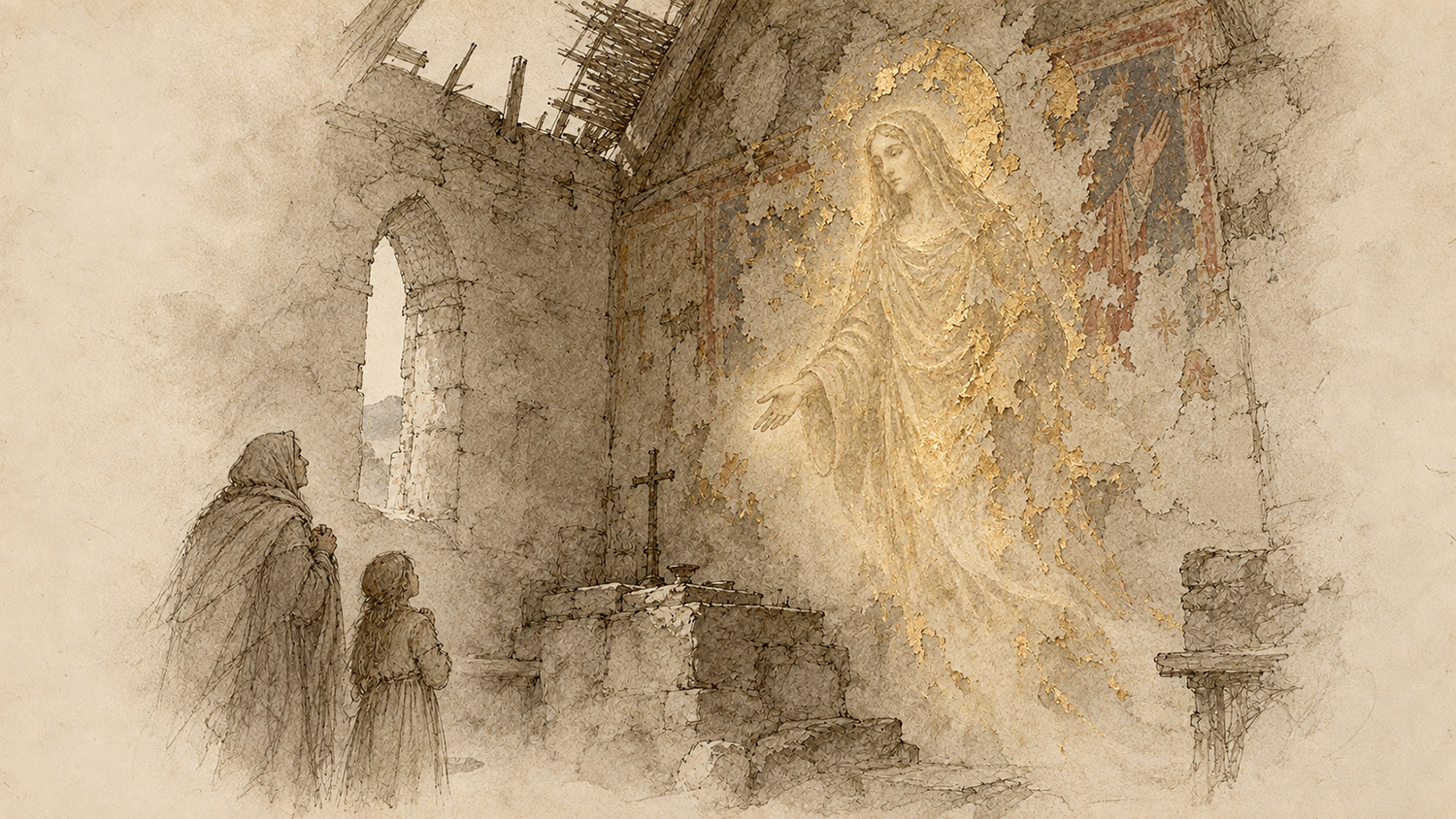
It was built before the Angles held this valley, when my grandmother’s people still worshipped as they pleased on their own ground. Small. Stone below, wattle above, long since fallen in on one side. The walls inside were painted once — I do not know by whose hand, only that it was done with care, and with gold where gold could be spared, which even then was not a thing spared lightly.
Most of it is lost now. Damp takes plaster the way it takes everything else given time enough. You can still see a robe here, a hand raised there, a halo that was once whole and is now a broken ring of colour with the gold flaking from it like scale from a fish left too long on the bank.
My grandmother took me there when I was a girl, before it was safe to be seen going. She said her mother had taken her the same way, in secret, because the ground we walked on by daylight belonged to other people now, but the chapel, she said, still belonged to whoever came to it with the right heart.
I saw the woman twice.
The first time I was too young to be frightened properly. I remember only that the far wall, where the paint was thinnest, seemed to gather itself into someone standing, the way steam gathers into shape above a pot before it is gone again. She did not have a face I could describe to you now, nor then. Only the shine of her. Not a candle’s shine, though there was a candle. Older than that. The gold on the wall, if gold could stand up and hold still.
My grandmother did not speak while it lasted. Afterward she told me only that we did not ask the gilded woman for anything, and we did not thank her either, because she was not there for our sake.
I asked whose sake she was there for.
My grandmother said she did not know, and did not think the woman knew either.
The second time was many years later, when I brought my own daughter, against my better judgement, because she would not stop asking after the place her grandmother had described to her. The paint has faded further since I was a girl. I did not expect anything to come of it.
She came anyway. Fainter, I think, though I cannot swear my eyes are not simply older and worse than they were.
My daughter saw her too. She said afterward that the woman had looked at her the way you look at someone you are trying to remember rather than someone you already know. Not unkindly. Only searching.
I do not go to the chapel now. Not from fear of her exactly. I do not think she has ever meant harm to anyone who came to her honestly.
I think, if I am honest myself, that I am afraid of what it would mean if one day I went and there was nothing there at all — no shine, no gathering of the light, nothing but damp plaster and a wall too far gone to hold even the memory of gold.
I would rather not know that yet.
—
*We went to the chapel ourselves before leaving the valley. Gildas measured what remained of the walls and noted the extent of the paintwork, more from habit than from any expectation of explaining it. Norwyn sat a long while before the faded wall Aedre had described, and drew nothing, though I watched him try three times and abandon the page each time.*
*I asked him why.*
*He said the wall would not hold still long enough on the page either.*