
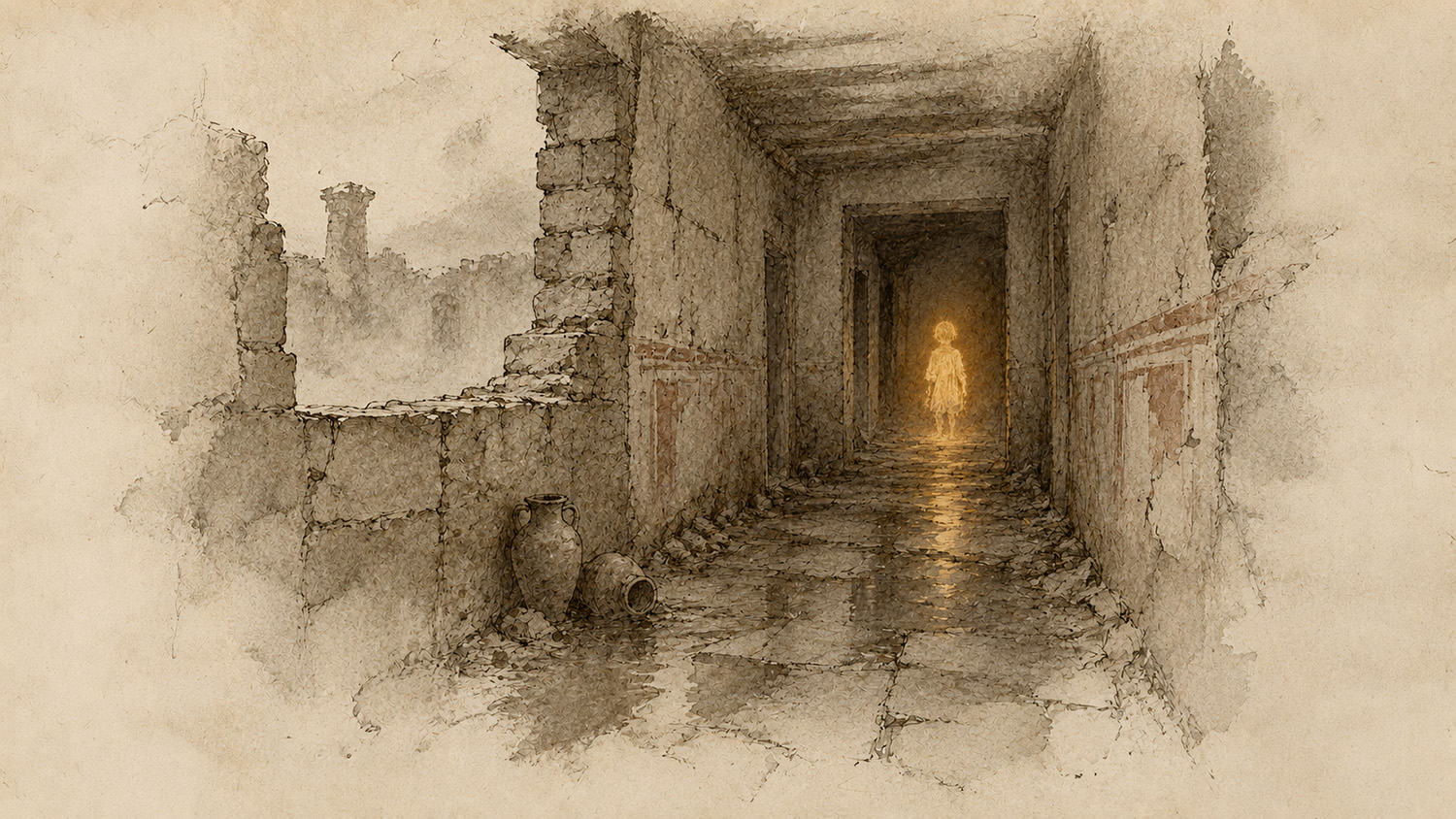
Year of Our Lord 557 From the Sketchbook of Brother Norwyn
Amber Child
Wilfrid asked me to set down what I would not say aloud. I do not write easily. These are not sentences so much as things I noted, in the order I noted them.
First evening. A child at the end of the path, where the trees close over it. Small. Standing, not walking. Gone before I had turned my head fully.
I thought it was the sun. It was low and behind him and I said nothing, because a boy lit gold by a low sun is not a thing worth troubling Gildas with.
Second evening. Same path. Same hour. I watched longer this time. The light did not move as the sun moves. It stayed on him, close, as though it belonged to him rather than to the sky.
Gildas says I imagine things when the light is poor. I did not argue. I am not certain he is wrong, generally. I am less certain tonight.
Third day, midday, indoors, no sun at all reaching that passage.
He was there again.
The same colour.
I did not imagine that.
I have tried to draw him four times now. Each time the same difficulty: the colour will not sit still on the page the way it sits on him. I have used every ochre and amber I possess and none of them are correct. He is not the colour of anything I have ground and mixed myself. He is the colour of something old that has been warmed for a very long time by hands, or by wear, the way a bead worn at the throat for years takes on a warmth no stone freshly cut ever has.
I think he is carrying something, though I have not yet seen it plainly. Small. Held close, the way a child holds a thing he has been told not to lose.
Wilfrid tried to speak with him near the well path at dusk. He says the boy looked at him — not frightened, not curious, simply looked, the way one looks at a person one is waiting for and has not yet decided is the right one. Then he was at the far end of the path instead of the near end, without, Wilfrid says, having crossed the distance between.
Wilfrid asked me afterward whether children so young go anywhere alone when they die. I told him I did not know. I do not think either of us believed the question was really about theology.
A woman near the mill spoke of amber, unprompted, when Gildas asked only whether any child had been lost near the house within memory. She said her grandmother had told her a child was buried once with a string of amber about his throat, traded up from the eastern coast at no small cost, because his mother would not let him go to the ground with nothing warm against his skin in a place so cold. She did not know if this was the same child. She did not know if it was the same house. She crossed herself and would say no more of it, though I do not think it was piety that stopped her.
Last entry, for now. I saw him a sixth time tonight, closer than before. He did not run from me, nor toward me. He simply held whatever he holds a little more tightly, as a child does when a stranger looks too long at something he is afraid will be taken from him.
I did not try to take it.
I do not think that is what he is afraid of losing, in any case.
I have drawn him once more. I have not shown Gildas. He will only ask what the boy is holding, and I have no answer that would satisfy him, or myself.

Not Yet Cast