
Year of Our Lord 557 Recorded by Brother Gildas
Ink Stained Monk
I record this one reluctantly, and for a reason I will explain at the end, though I suspect Wilfrid will say I have explained too much already by the time I reach it.
We were shown the room by the brothers of a small house of prayer built, they told us, before their own order held it — a British foundation, older than any of them, kept on rather than pulled down when the land changed hands, as such places sometimes are, because a house of God is a house of God whatever tongue is spoken over it.
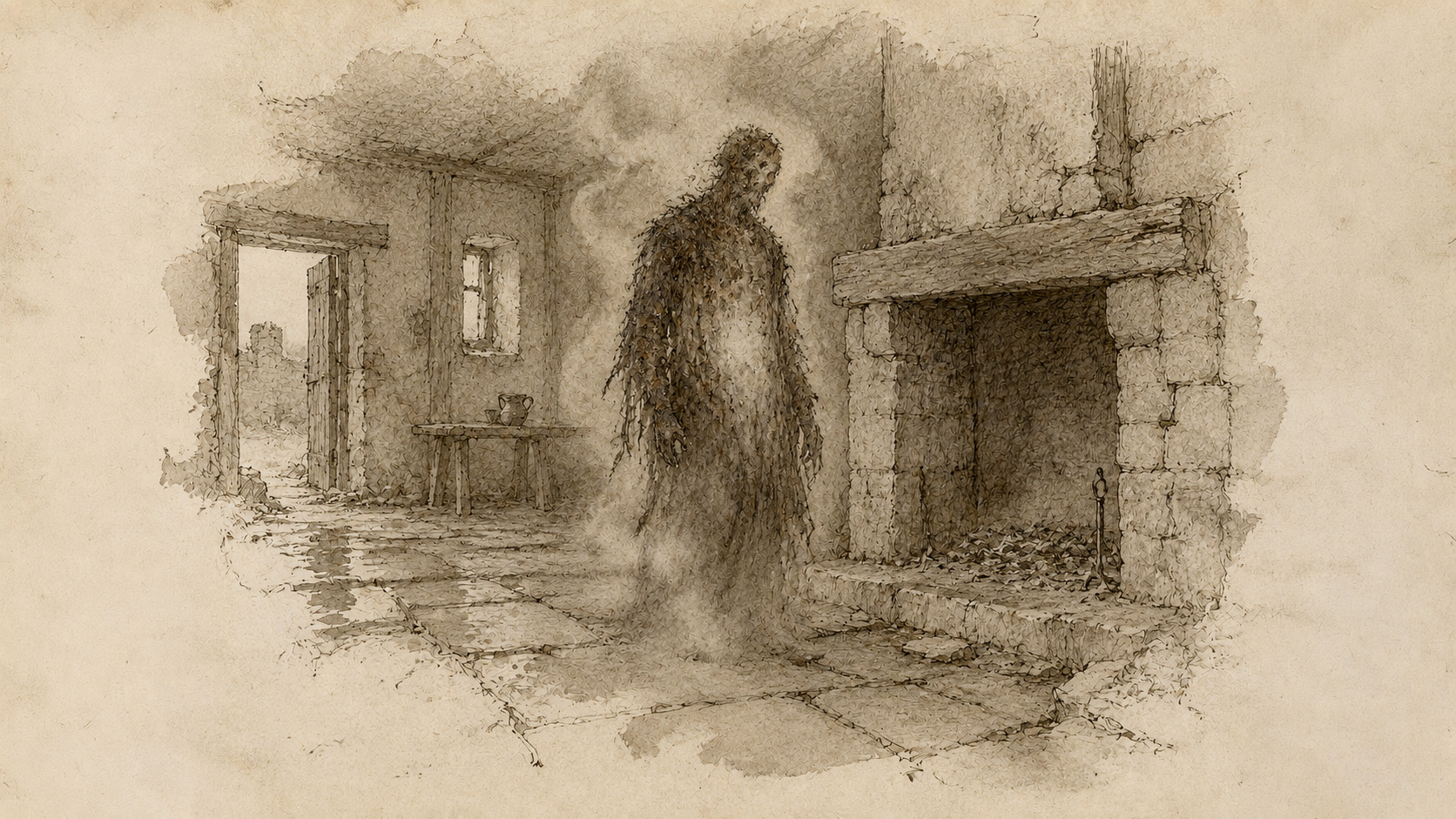
In the corner of what had once been a scriptorium, a figure sat bent over a table that no longer held a table’s worth of anything. No parchment. No board. No stylus. Only the posture of a man who has one, and the stillness of a man who has held that posture for longer than any living back could bear.
He did not look up when we entered. He did not look up at any point during the three nights we kept watch there. His hands moved, slowly, in the motion of a pen crossing a line and returning to begin the next, though there was no pen, and I could discern no ink upon fingers that were not, in any case, fingers I could properly see.
His robe, where it could be made out at all, was the colour of old parchment left too near a damp wall — brown going to grey, marked all over with darker patches that put me in mind of nothing so much as ink long dried into cloth.
The brothers of the house told us he had been seen in that corner for longer than any of them had held their vows, and longer, by their account, than the oldest among them could recall being told of him by those who held their vows before. Nobody had given him a name. Nobody claimed to know which of the old brothers he might once have been.
I asked whether any record remained from the house’s earlier days — before the change of hands, before the order now keeping it. They showed me what they had, which was little, and most of that little in poor condition. Water had reached the lower shelves at some point in the past and taken what it pleased.
I found the stains on the third page I examined.
They matched him. Not in shape exactly — I will not claim so precise a correspondence — but in character. The same darkened patches, the same manner of spreading along a fold, as though whatever had marked the parchment and whatever marked the man had come from the same source, or the same accident, or the same hand.
The page itself told me nothing. What text had once occupied it was gone beneath the very staining that interested me — the ink that ruined it and the ink that had once been legible upon it were, by now, indistinguishable from one another. I could make out perhaps four whole words across the entire leaf, none of them consecutive, none of them sufficient to tell me whether I held a psalm, a chronicle, a letter, or an old brother’s private grief set down where he thought no one would read it.
Whoever he was, and whatever he wrote, the writing and the writer appear to have been lost by the same misfortune, at the same time, in a manner I cannot presently account for.
I put this to Wilfrid, who said only that perhaps that was the misfortune itself — not that he died, whenever and however he died, but that whatever he spent his life setting down did not survive him, and that this is why he does not look up. He has not finished. He does not know, perhaps, that finishing is no longer possible.
I did not care for that answer when he gave it. I care for it somewhat less now, having had two nights since to consider it further, because it does not admit of the kind of proof I generally require before I will accept a thing as true, and yet I have found no better explanation with which to replace it.
This, then, is the reason I record this one reluctantly. We three keep our own chronicle, night after night, of men and women who are not forgotten because we have taken it upon ourselves that they should not be. I confess I did not enjoy sitting three nights in the presence of a man who kept exactly such a chronicle himself, by exactly such a discipline, and lost the whole of it regardless.
I do not know his name. I have set down what I can of him here instead, which is the only remedy I have to offer, and which I am aware may prove no remedy at all.