
Year of Our Lord 557 Recorded by Brother Gildas
The Wisp
The Light Beyond the Heather
We went out because a shepherd would not go out himself, and asked us to go in his place, which is not the usual order of things, but he was frightened in a manner I have learned not to argue with.
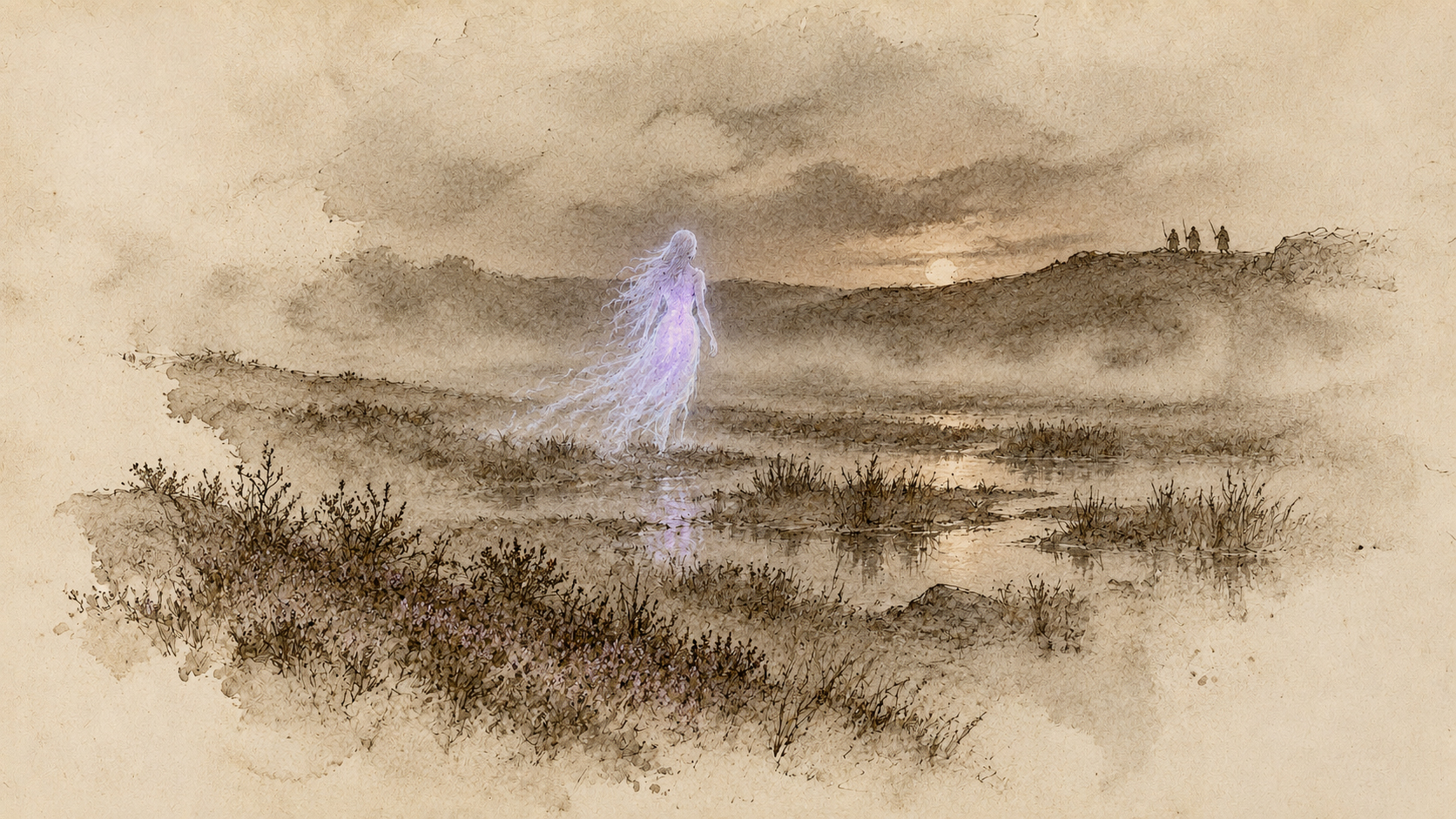
The ground beyond the heather falls away into marsh before it rises again toward the far ridge, and it was there, he said, that the light could be seen most evenings once the dark had properly settled — violet at its heart, pale blue toward its edges, moving low over the ground at no greater pace than a person walking.
We saw it ourselves within the hour.
Wilfrid thought it flame at first, and said so. Norwyn did not answer him. I asked Norwyn directly what he thought it was, since he is not usually slow to say when something troubles him, and he said only that he thought there was something walking inside it, which I took at the time to mean he thought it a woman carrying a light, and did not press him further.
We were wrong, or he meant something other than what I understood, because as we drew nearer the light did not reveal a woman carrying anything.
The light became the woman.
I do not know a better way to set it down than that. There was no moment I could point to and say, there, that is where light ended and she began. She simply was the light, walking, and then she was a woman who happened to still be lit that colour, and I could not have told you when the one gave way to the other.
She did not turn to us. She did not alter her pace for our approach, nor quicken it, nor slow it. She crossed the wet ground toward the ridge at exactly the speed she had been moving before we arrived, and continued at exactly that speed until the dark on the far side of the marsh had taken her, at which point the light went with her, and we were three men standing on a moor in full darkness with no more sense of what we had seen than the shepherd had given us before we set out.
We did not follow. I will state plainly that this was my judgement and not cowardice, though I invite anyone who was not present to judge that claim as they see fit.
We returned at first light.
The ground there holds a footprint well, being wet through and soft nearly to the ankle in places. I walked the line she had taken, or as near to it as I could judge by memory, expecting to find nothing, or to find something I could not account for, and prepared myself for either.
I found three sets of footprints.
Mine. Wilfrid’s. Norwyn’s.
Ours, and only ours, laid down that morning as we walked the ground ourselves. Nothing beneath them. Nothing beside them. The wet earth she had crossed the evening before, at whatever pace, in whatever shape, had not been marked by her passing at all.
Norwyn said, as we stood there, that he had counted four of us on the ridge the evening before, while we watched her cross.
I told him he was mistaken. There are three of us. There have only ever been three of us.
He did not argue the point. He rarely does. But he did not agree with me either, and Wilfrid, who is generally the first to smooth over a disagreement between us, said nothing at all on the matter, which I noted at the time and note again now, setting this down.
The shepherd will not go near the marsh after dark, and I find, having seen what I have seen, that I am not inclined to think less of him for it. The older people of that place say the marsh has always taken what is given to it and given nothing back in kind — an old belief, older than any teaching we carry with us, from a time when things were put into such ground on purpose, by hands that meant it as an offering rather than a loss. I do not know whether she is owed to that custom or to some more recent and more ordinary grief. I know only that she left no mark on ground that holds a mark from every other living thing that crosses it, ourselves included, and that I have no explanation for this which I am willing to commit to writing as though it were fact.